Parenting Tweens: AKA, How to Cherish the Mystical Creature that Sometimes Body-Snatches Your Child.1/8/2017 
Based on my personal experience, I could have titled this blog, “Who are these tweens in my house and what have they done with my adorable kids?!” But, alas, it can’t be all about me. And, my kiddos (a newly nine year old and a 12-going-on-19-year old) sometimes do show up as the most adorable versions of themselves. However, the tween phase, which spans from 8-14 years, definitely dishes out some intensity that leaves me longing for the days when I could scoop up my kids and buckle them into the car seat for a much needed “reset.” To debunk some of what’s going on with your tween and give you a roadmap to at least know what you’re up against, let’s break things down and look at tweens from the inside out.
What’s Up with Your Tween’s Brain? During the tween years, one major brain change occurs that may leave you wondering if your child has lost his or her mind. Your tween is facing the task of abandoning simple, straightforward, “concrete thinking” and practicing more “abstract” reasoning. What does this mean? It means that your child is dipping a toe, or a foot, or cannon-balling into a whole new world of thoughts and possibilities. Many of these new insights will be fantastic and exciting. Some will be terrifying and overwhelming. And, as if that’s not enough, your tween will not transition smoothly from one mindset to the other. Instead, you’ll watch as your child teeters back and forth between maturity and fart jokes or infantile silliness…often scratching your head wondering which version of your child will come to the dinner table. How to Parent Through This:
What’s Up with Your Tween’s Feelings? Getting back on the roller coaster, let’s talk about emotions. We can’t have a discussion about the transition from childhood to adolescence without mentioning hormones. These powerful substances pump through your tween’s body and trigger a host of shifts and changes that impact far more than height, hair growth, and body odor. Mood swings are bound to happen. You know, those bouts of crying, irritability, irrational anger, or sulking that leave you asking, “What did I miss?!” You’ll likely see your child begin to depart from his or her typical emotional highs and lows to new and uncharted territories all thanks to the biology of growing up. How to Parent Through This:
What’s Up with Your Tween’s Social Scene? The word tween says it all—these kids are in between. Not little enough to always pull off the playful, carefree childlike wonders of dolls and blocks and kitchen sets; not fully equipped to dive into the world of boys who like girls who like boys and “hanging out” instead of having “play dates.” And, your child’s friends are all going through this too, but at their own pace. You may see some peers who appear to be much older or more mature than your child and others who don’t seem to be interested in acknowledging the major changes that are about to happen. Your tween is trying to navigate this on a daily basis and the urge to hold onto the wonders of childhood will battle with the primal instinct to keep up with the pack because, after all, being left behind doesn’t feel good, right? How to Parent Through This:
What’s Up with Your Tween’s Body? Back to biology, things are changing. Hair is showing up in new places, which may delight or terrify your tween. Pimples and blackheads, foreign concepts that are suddenly life altering, may enter the scene. Things smell different, act different, and look different. Your tween is aware of these changes whether or not he or she is talking about them. More than that, your tween is probably well aware of the changes taking place around them, especially as gym class begins to include locker room changes and social media opens the door to a whole new world of social comparison (most of which is filtered and staged). How to Parent Through This:
JOIN Dr. Stephanie for Facebook LIVE on Monday 1/9 @ 8:40am CLICK the link. LIKE the page. Get parenting tips that work in the real world! 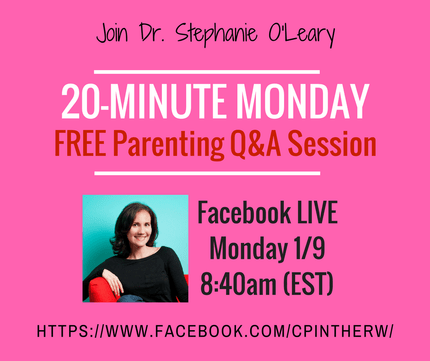
0 Comments
Leave a Reply. |


Stephanie O'Leary, Psy.D.
Sharing practical strategies that help parents rediscover joy in their children (even when someone's crying, the phone is ringing, and it smells like the house may be burning down) Archives
October 2017
Categories |
 RSS Feed